



Course Categories
Product Categories
Best Full Stack Training Institute in Hyderabad
100% Job Oriented Training & Placement Assistance

Unlock Your Potential: Master Full Stack Development with Monopoly IT Solutions!
Here's a comprehensive industry-oriented Full-Stack Developer course outline designed to prepare learners for real-world challenges and requirements. This content focuses on modern technologies, tools, and best practices for building scalable and maintainable applications.In today's technology-driven world, the demand for versatile developers who can navigate both the front-end and back-end of web applications is skyrocketing. Full stack development has emerged as a vital skill set, allowing developers to create seamless user experiences while managing servers, databases, and application logic behind the scenes. If you're an aspiring developer eager to dive into this expansive field, you've landed in the right place. This comprehensive guide will equip you with the essential knowledge, tools, and strategies to master the art of full stack developmen
Full Stack Developer : A Versatile Role in Software Development
Full stack development refers to the practice of working on both the front-end and back-end aspects of web applications. A full stack developer is someone who is proficient in both client-side (front-end) and server-side (back-end) technologies.
The front-end involves everything the user interacts with directly, such as the design, layout, and functionality ofweb pages. On the other hand, the back-end handles the server, database, and application logic,which work behind the scenes to power the web application solutions.O... Read More
The back-end, meanwhile, is responsible for the server-side logic, data processing, and storage. Full stack developers often work with server-side programming languages such as Python, Java, Ruby, or PHP, and use frameworks like Django, Flask, or Node.js. They also interact with ... Read More
A database is an organized collection of structured data, typically stored and accessed electronically from a computer system. Databases are designed to efficiently manage, store, and retrieve data, which can be anything from customer information to financial records or inventory... Read More
Skill Set for Full Stack Developer
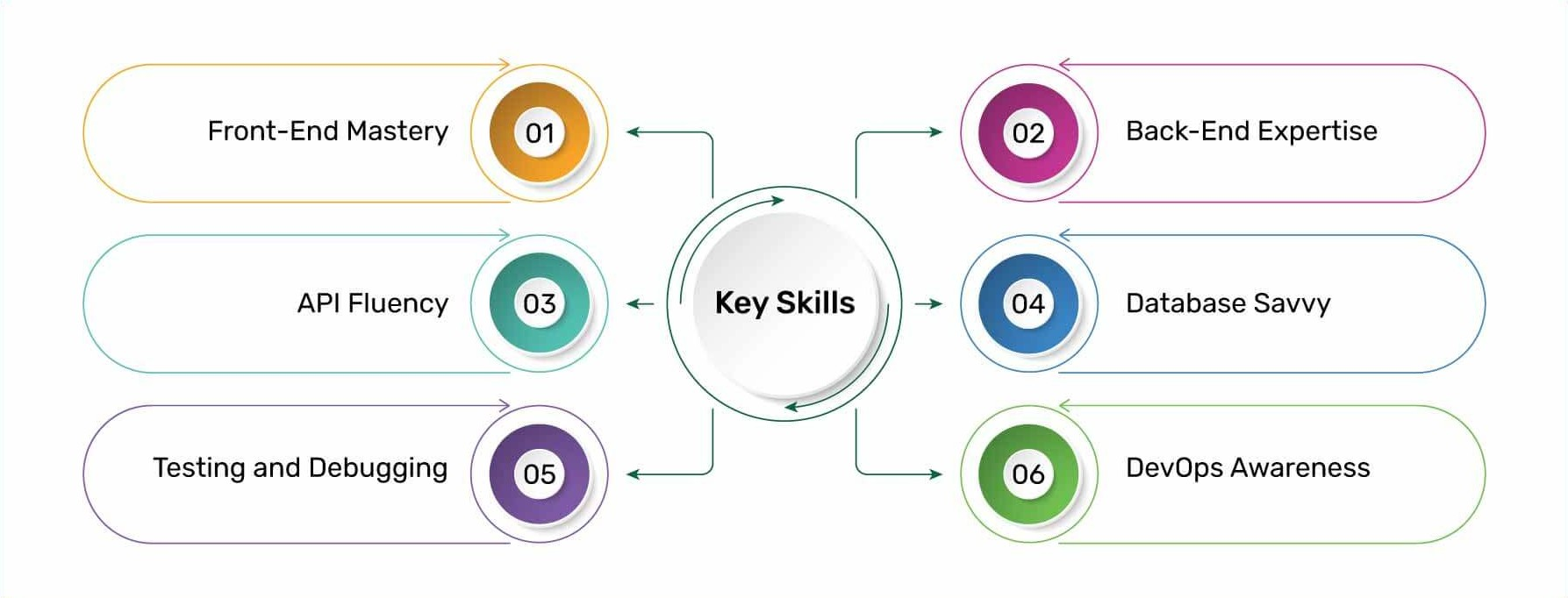
A full stack developer must be skilled in integrating the front-end and back-end, ensuring seamless communication between the client and server. They are responsible for deploying and maintaining the application, managing the hosting infrastructure, and optimizing performance. This role requires strong problem-solving skills, attention to detail, and the ability to work with diverse technologies. In today's tech landscape, full stack developers are highly valued due to their versatility and ability to handle all aspects of web application development, from initial design to deployment and maintenance.
Full Stack Developer Modules
- Overview of Full-Stack Development
- What is Full-Stack Development?
- Role of a Full-stack Developer
- Front-end, Backend, and DevOps
- Development Methodologies
- Agile and Scrum methodologies
- Version Control Systems (Git/GitHub/GitLab)
- Tooling and Environment Setup
- Code editors (VS Code, JetBrains)
- Terminal basics and shell scripting
- Node.js and Package Manager (npm/yarn)
- Core Concepts
- HTML5: Semantic elements, forms and accessibility
- CSS3 : Flexbox, Grid, Animations, and Responsive Design
- Javascript(ES6+): Syntax,DOM Manipulation and event handling
- Front-End Framework and Libraries
- React: Components,State,Props and Hooks
- Advanced React : Context API, Redux and React Router
- Angular: Components, Directives, Pipes, Life Cycle Hooks and Services etc
- Advanced Angular :SSR, RxJS, NgRx Store....
- UI/UX Design
- Figma/Adobe XD basics
- Material Design and Bootstrap
- Front-End Testing
- Unit testing with Jest
- End-to-end testing with Cypress or Playwright
- Server-Side Programming
- DotNet/Java/Python/NodeJs
- RESTful APIs and MVC architecture
- Database Management
- Relational Databases:MySQL/MS SQL Server/Oracle/PostgreSQL
- NoSQL Databases:MongoDB
- ORMs:Sequelize/Mongoose
- Authentication and Authorization
- Session-based and Token-based Authentication(JWT)
- OAUTH and Social Logins
- Web Security
- Common threats:SQL Injections, XSS, CSRF
- Secure coding parctices and HTTPS
- Microservices Architecture
- Building and managing microservices
- Tools:Docker,Kubernetes
- Connectiong Front-End and Back-End
- API integration and handling asynchronous requests(Axio,Fetch)
- Real time communication with WebSockets(Socket.io)
- Full-Stack Project
- Building a real-word application :E-commerce,Social Media or a Task Manager
- Implementiong CRUD operations and user authentication
- Cloud Platforms
- Deploying applications on AWS, Azure, or Google Cloud
- Serverless Architecture (AWS Lambda, Firebase)
- Continuous Integration and Deployment (CI/CD)
- Tools: Jenkins, GitHub Actions
- Containerization
- Introduction to Docker and Docker Compose
- Performance Optimization
- Load balancing and caching
- Profiling and monitoring tools
- Version Control and Collaboration
- Advanced Git workflows: Rebasing, Merging, and Branching
- Team collaboration tools (Slack, Jira, Trello)
- Advanced JavaScript
- TypeScript Basics
- Functional Programming and Error Handling
- Advanced Data Handling
- GraphQL APIs
- Streams and Queues (Kafka, RabbitMQ)
- Testing and Debugging
- Advanced Debugging tools (Chrome DevTools, Postman)
- Performance testing and benchmarking
- Build and Deploy a Complete, Industry-Standard Full-Stack Application
- Responsive front-end
- Secure back-end with APIs
- Cloud deployment with CI/CD pipelines
- Database integration and testing

Book for More Details!
Daily Training Updates
Testimonials
Quick Links
Trending Courses
- Web Development
- C#.Net
- Python
- Java
- Data Science
- AI & ML
- SnowFlake (coming soon)
- AWS & DevOps
- Azure & DevOps
- Power BI
- Digital Marketing
- HR Training
- SAP (coming soon)
- Scrum Master (coming soon)
- Business Analyst (coming soon)
- Tableau
- Salesforce Training
- Oracle DBA (coming soon)
- Software Testing (Manual & Automation) (coming soon)
Corporate Training
Institutional Training
Inhouse Training
Services
Address
Monopoly IT Solutions Pvt Ltd
2nd Floor, Maruthi Complex, Opp. R.S. Brothers, KPHB
Hyderabad, Telangana - 500 072, India